

Bowling by Jason Belmonte
WannaPlay Studio Ltd
I approached Bowling by Jason Belmonte as the kind of game you open when you want a quick sports session without setting up a console or finding a real bowling alley. It is a free sports game from WannaPlay Studio Ltd, built around 3D bowling, physics-based ball movement, and online competition. After spending time with it, I found that its main appeal is not simply knocking down pins; it is learning how small changes in aim, release, and spin affect the result.
That focus gives the game a more thoughtful rhythm than a basic tap-to-bowl title. You can play casually, but the physics encourage you to pay attention. A shot that looks almost right may leave an awkward split, while a slightly adjusted angle can turn the same setup into a much cleaner result. The most important thing to understand is that control matters more than speed. If you treat every turn as a quick swipe, the game can feel inconsistent. If you slow down and read the lane, it becomes much more satisfying.
Why the physics are the real attraction
The central capability here is the realistic ball behavior. The game presents bowling as a three-dimensional simulation rather than a simple animation where the outcome is mostly decided before you release. The ball’s direction, curve, and contact with the pins all contribute to what happens next. That makes each throw feel like a small problem to solve.
I especially liked that the physics give ordinary shots a useful sense of consequence. A ball sent too far toward the outside can drift away from the pocket, while a shot with the right amount of curve can arrive at the pins with much more force. This does not turn the game into a professional coaching tool, but it does reward players who experiment instead of repeating one gesture mechanically.
For beginners, the physics may initially seem less forgiving than the usual casual bowling alternatives. In many simple mobile games, you can point at the pins and expect a reasonable result. Here, a small mistake in the starting line or release can remain visible all the way down the lane. I see that as a strength for players who want a game to learn, although it may frustrate anyone looking for instant, almost automatic strikes.
Related News

Threads in Real Life: Who Should Join, Lurk, or Leave

How SHEIN Turned Shopping Into an Endless Content Feed

How to Make Fortnite Feel Smarter on Mobile

Should You Switch to Microsoft Outlook on Mobile?

Why Gallery Keeps Pulling Users Back

X Review: Why Its Network Still Matters
The three-dimensional presentation also helps with judging the shot. You are not only choosing left or right; you are considering the lane as a space. That extra perspective makes the game feel closer to bowling than a flat score-chasing toy. It also means that the best results come from building a repeatable routine rather than relying on dramatic last-second movements.
Learning the release instead of chasing lucky strikes
My practical advice is to begin by making controlled throws. Aim for a consistent starting position, use a moderate movement, and watch where the ball enters the pins. Do not change everything after one poor frame. If the ball repeatedly misses on the same side, adjust one part of the shot at a time. This makes it easier to tell whether your problem is the angle, the release, or the amount of spin.
That approach reveals one of the less obvious strengths of the game: it can function as a short practice exercise for observation. You start noticing whether a ball is missing because it is too straight, because it is curving too early, or because it reaches the pocket without enough useful angle. The game does not need to explain every correction in a long tutorial for this learning loop to work; the lane gives you immediate visual feedback.
Gallery
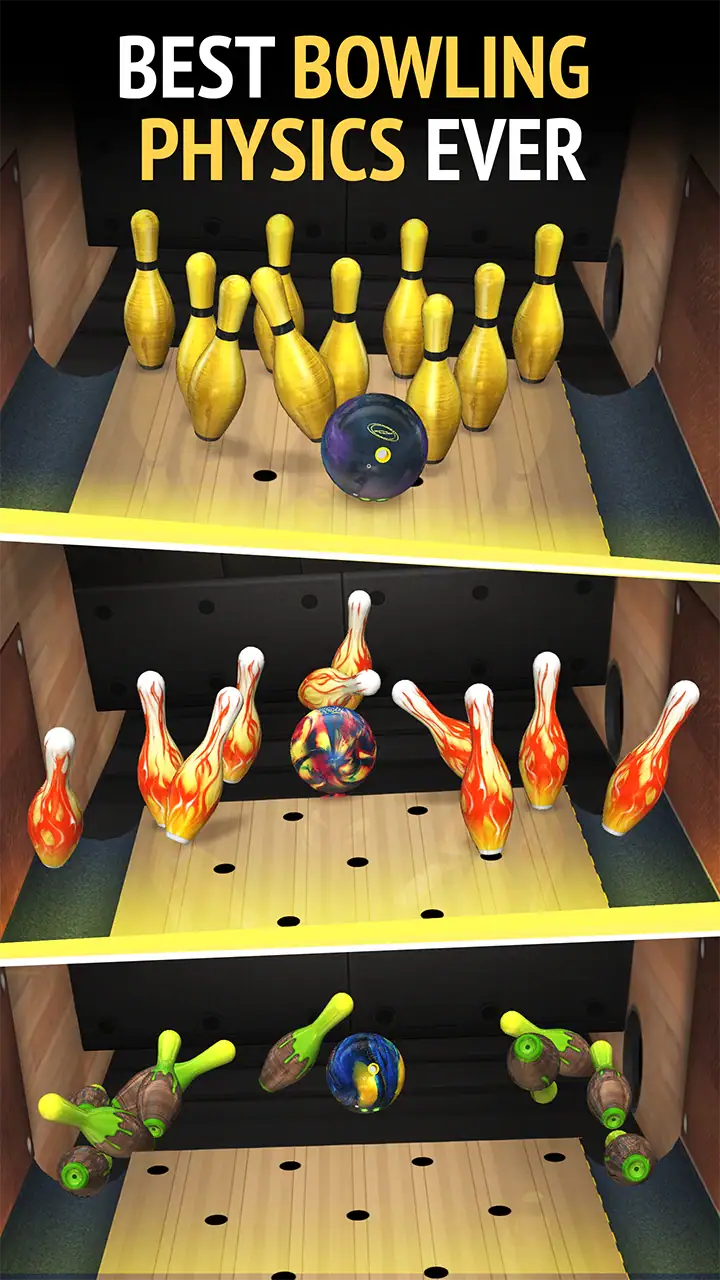
Another useful habit is to resist overcorrecting. A missed shot can tempt you to drag much farther in the opposite direction, but that often creates a new problem. Small adjustments are usually easier to evaluate, especially when you are trying to understand how the ball reacts. This is where the realistic physics become more than decoration: they turn each attempt into information for the next one.
I would not recommend judging the game during the first few throws alone. The controls may feel unusual until your hand learns the relationship between movement and ball path. Once that connection becomes familiar, the game feels less random. Players who enjoy improving through repetition will likely appreciate this transition more than players who want a fully predictable one-touch experience.
What a normal session feels like
In everyday use, I can imagine opening it during a short break, playing a few turns, and closing it without needing a long commitment. That works because bowling naturally divides into compact actions. Each throw has a clear beginning and end, so the game suits small gaps in the day better than sports games that require a full match before progress feels meaningful.
A realistic scenario would be playing after work while waiting for dinner or during a commute break. I would start with a few practice throws, then move into online competition when I felt settled. The important distinction is that I would not begin a competitive session while still experimenting with the controls. A poor first attempt can be part of learning, but it is less enjoyable when the result immediately affects a competitive game.
The online element gives the physics a reason to matter. Against another player, a lucky strike is welcome, but consistent control becomes more valuable over several turns. You have to decide whether to repeat a reliable line or attempt a more ambitious shot. That creates a useful tension between safety and potential reward, particularly when a difficult pin arrangement tempts you to take a risk.
For solo players, the same system can still be engaging because every throw offers a chance to refine technique. However, the game is more compelling for someone who enjoys measuring improvement against other people. If your ideal sports game is entirely relaxed and offline, the competitive side may feel less important than the physics practice.
How to approach online competition
I found that the best way to enter online matches is to treat the first stage as a test of consistency rather than a showcase of fancy shots. Use the opening turns to confirm how your chosen line behaves. If the ball is entering too high or too low, make a measured change instead of abandoning the entire approach. This is particularly useful when connection timing or opponent pressure makes you want to rush.
Competition also changes how you think about a spare. In a casual session, you may focus only on strikes, but a controlled spare can be the smarter choice when the pins are spread out. The realistic physics make those situations more interesting because you must consider contact and direction, not just whether the ball reaches a target area.
One trade-off is that online play can make small control mistakes feel more significant. A missed shot in practice is useful feedback; the same mistake during competition can feel costly. I recommend using the noncompetitive side of the experience to build a comfortable release before treating online matches as the main attraction. That simple separation makes the game feel less stressful and helps the competitive feature show its strengths.
The best use case for this particular game
The strongest scenario is a player who likes sports games with a clear skill curve and wants sessions that can be either brief or competitive. You do not need to know real bowling terminology to begin, but curiosity helps. The more willing you are to observe ball movement and adjust gradually, the more value you get from the simulator-style design.
I also think it suits friends or family members who want to compare technique without learning a complicated control system. One person can focus on straight shots, another can experiment with spin, and both can see the results immediately. Because the rules of bowling are familiar, the challenge comes from execution rather than from understanding a large set of game systems.
It is less suitable for someone who wants a heavily decorated arcade experience where every throw produces exaggerated effects. The game’s appeal comes from the lane, the pins, and the behavior of the ball. If you need a constant stream of visual rewards or a broad adventure structure, this focused format may feel narrow.
The age rating is Everyone, which makes the basic concept accessible to a broad audience. Still, accessibility in the rating sense does not mean every player will find the controls effortless. Younger or inexperienced players may need a little time to understand why a fast movement is not automatically a powerful or accurate one. I would introduce it as a game of controlled gestures rather than a game of frantic swipes.
Where the free model fits
The game is free to download, which makes it easy to try the core bowling experience before deciding whether it deserves regular space on your device. There are in-app purchases ranging from $0.99 to $99.99 per item, so I would approach optional spending carefully. The sensible starting point is to play without buying anything and decide whether the physics and competition are enjoyable on their own.
This matters because the game’s main value is skill-based. If you are still learning how to aim and release, spending money will not replace practice. A purchase may be more appealing to a committed player who already enjoys the game, but newcomers should first see whether they like its deliberate pace and competitive pressure.
I also recommend setting a personal spending limit before exploring optional purchases. That is not a criticism unique to this title; it is simply good practice for any free mobile game with a wide purchase range. The free entry point is a genuine advantage, but it should not encourage you to treat every optional item as necessary for enjoying a few bowling sessions.
Device expectations and long-term appeal
The game supports devices running Android 6.0 or later. That makes it available to many older Android users, although actual comfort can still depend on the device’s screen, responsiveness, and general condition. Since the experience depends on precise gestures and visual judgment, a phone that handles touch input poorly could make the controls feel worse than they are.
The current version is 1.907, and the game has been available since Aug 23, 2017. Those details suggest a title with a long presence rather than a brand-new experiment. In my view, that is useful for a focused sports game: the basic idea does not depend on chasing a temporary trend. Its lasting appeal comes from whether you enjoy improving your bowling line and competing with others.
Its audience is also substantial, with over 500 thousand installs, an average rating of 4.5, and around 18 thousand ratings. Those figures make it easier to see why the game has found a place among mobile sports titles, but they should not replace your own judgment. A well-rated physics game can still be the wrong choice if you prefer automatic controls, offline-only play, or a much broader range of sports.
What I would compare before choosing it
Compared with a traditional bowling game on a console, this is more convenient and easier to play in short sessions, but it naturally offers a smaller screen and a less substantial overall presentation. A console option may be better for local multiplayer, a larger display, or players who want a fuller sports package. This game is better when the priority is quick access to a dedicated bowling experience.
Compared with very simple mobile bowling games, it asks more from the player. The reward is a stronger sense of control, but the cost is a learning period and occasional frustration. If you want to pass time with almost no concentration, a simpler alternative may suit you better. If you want your release to matter, this title has the more interesting foundation.
It also differs from real bowling in an important way: the phone gives you a compact, repeatable environment, while a real lane adds physical weight, approach timing, and environmental variation. I would not use the game as a replacement for visiting a bowling alley. I would use it as a convenient way to think about lines, angles, and consistency when a real lane is not available.
Small habits that make the game more enjoyable
First, create a repeatable pre-shot routine. Look at the pins, choose a line, make the same kind of movement, and only then evaluate the result. This prevents random changes from hiding the reason a throw failed.
Second, separate practice from competition whenever possible. Testing a new release is useful, but doing it in an important online match can turn learning into unnecessary pressure. Build confidence with familiar shots, then introduce one new adjustment at a time.
Third, judge improvement by control rather than by strikes alone. A shot that leaves a manageable spare may show better technique than a lucky strike produced by an uncontrolled movement. This mindset makes the game more rewarding over time and reduces the feeling that every turn must be perfect.
Finally, pay attention to your own screen and hand position. A comfortable grip and a clear view of the lane make precise gestures easier. This is a practical point that store descriptions rarely explain, but it can make a noticeable difference in a game where a small movement changes the ball’s path.
My recommendation after playing
I would recommend this bowling game to players who want a focused sports title with realistic-feeling physics and an online competitive angle. Its strongest quality is the way it makes the ball’s path matter. You are not merely selecting a result; you are learning how a shot develops and using that information to improve the next one.
I would skip it if you dislike repetition, become frustrated by gradual control learning, or want a broad sports collection instead of a dedicated bowling simulator. I would also choose a different option if local multiplayer on a large screen is your main priority. Those are meaningful limitations, not minor details, because the game is intentionally centered on one activity.
For me, the best reason to keep it installed is the combination of short sessions and a skill curve that remains understandable. A few throws can fill a spare moment, while online competition gives more committed players a reason to return. Developed by WannaPlay Studio Ltd and offered free with optional purchases, it is easy to test without a financial commitment. If you enjoy adjusting one variable, reading the result, and trying again, this is a surprisingly engaging mobile bowling experience.
FAQs for Bowling by Jason Belmonte
What is Bowling by Jason Belmonte?
Bowling by Jason Belmonte is a mobile bowling game built around the style and personality of professional bowler Jason Belmonte. It lets you play bowling matches using touch controls, compete across different challenges, and work toward better scores. The game is aimed at both casual players and bowling fans who want a quick, easy-to-learn sports experience on a phone or tablet.
How do you play Bowling by Jason Belmonte?
Gameplay generally focuses on controlling the bowling ball with touch gestures. You can adjust your position, aim toward the pins, set the shot’s power, and add spin before releasing the ball. The controls are simple enough for beginners, although consistent strikes require practice. Learning how the ball reacts to angle, speed, and spin is important when facing more difficult opponents or challenges.
Is Bowling by Jason Belmonte free to download?
Bowling by Jason Belmonte may be available as a free download, depending on the platform and region, but users should check the current store listing before installing it. Free versions can include advertisements, optional purchases, or other limitations. Reviewing the app’s Google Play or App Store information is recommended so you understand any costs, permissions, and account requirements in advance.
Can Bowling by Jason Belmonte be played offline?
Some parts of Bowling by Jason Belmonte may work without a continuous internet connection, particularly basic single-player gameplay, but availability can depend on the version installed. Online features, advertisements, leaderboards, updates, or purchases may require internet access. If offline play is important to you, test the game after installation and check its latest store description for current connectivity requirements.
Is Bowling by Jason Belmonte suitable for children and beginners?
The game is generally approachable for beginners because its bowling mechanics are easier to understand than a full simulation. Children may also enjoy the short matches and straightforward touch controls, but parents should review the age rating, advertising, and possible in-app purchases before allowing unsupervised play. Difficulty can increase as you progress, so younger players may need time to master aiming and spin.
Pros
- Realistic physics make ball control and pin action feel satisfying.
- Simple controls are easy to learn for casual players.
- Jason Belmonte branding adds appeal for bowling fans.
- Matches are quick
- making it suitable for short gaming sessions.
- Works well as a relaxed
- pick-up-and-play sports game.
Cons
- Limited gameplay variety can make longer sessions feel repetitive.
- Advanced techniques may take time to master accurately.
- Progression may feel slower without frequent play.
- Visual presentation is functional rather than highly detailed.
- Some features may require an internet connection or in-app purchases.


